← Demo LabINDEPENDENT CONCEPT · DESIGN REVIEW
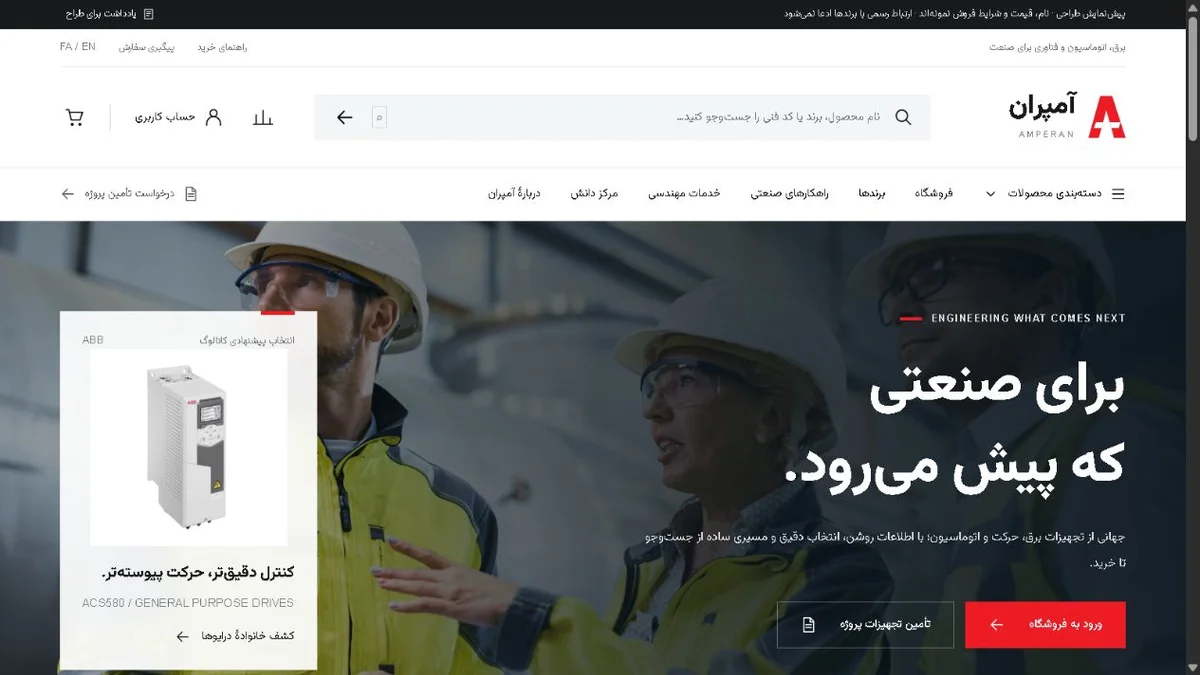
AMPERAN / INDUSTRIAL COMMERCE DESIGN PROPOSAL / 01
Make the right equipment easier to buy.
A multibrand industrial storefront that brings product discovery, technical information, direct purchase and project quotations into one coherent journey.
WORKING DESIGN PROTOTYPE↗
01 / UNDERSTAND THE FRICTION
An industrial purchase starts with a decision, not a shopping basket.
Working hypotheses to validate with your team.
01
A model name alone does not define an orderable item.
02
Missing price or availability needs a clear quotation path.
03
A project buyer needs to send a list, not repeat a form for every item.
THE DESIGN RESPONSE
Design for both the quick purchase and the considered project.
Keep exact specifications, documents and sales conditions beside the decision.
Offer a basket for priced items and a quotation route for project requirements.
01
Search ACS580 and compare two products.
02
Open a product, change the quantity and inspect the basket.
03
Try guest checkout with sample data, then explore a project inquiry.
01 / DIRECT PURCHASE
I know the part I need.
Search the code → confirm the exact variant → review price and stock → guest checkout.
02 / PROJECT QUOTATION
I need help specifying a project.
Share the equipment list → clarify specifications → review the commercial offer → confirm the order.
03 / DEFINE THE VALUE
What would make this worth building?
Design earns its place when it improves a real process. Capture a baseline, test a limited release and compare the same measures.
- Product-search success and searches with no result.
- Qualified quotation requests and time to first useful response.
- Checkout completion, order errors and actual contribution per order.
SCENARIO / NOT A FORECAST
Put your own numbers into the decision.
Every starting value is fictional. This simple model shows sensitivity to assumptions; it does not predict demand or guarantee a return.
Illustrative net monthly contribution——
Contribution means revenue minus variable costs. Include support, payment, returns and other relevant costs. Capacity limits, seasonality, taxes, financing and time to ramp up are not modelled.
Monthly model: inquiries × (additional percentage points ÷ 100) × contribution per order − additional operating costs. Simple payback: initial investment ÷ positive monthly result. These are not Reza’s fees or an ROI commitment.
04 / A CONTROLLED FIRST RELEASE
Launch one trustworthy category before expanding the catalogue.
A curated catalogue, code-level product model, verified sales content, basket/quotation rules and one end-to-end tested purchase path. Catalogue size, platform, integrations, price and dates follow discovery.
Define
Map the current workflow, constraints and baseline. Agree on a written scope and acceptance criteria.
Design
Review the important journeys with representative content before implementation.
Build & verify
Implement the agreed scope, test integrations and review real content with the owner.
Launch & learn
Hand over source and operating notes, agree support boundaries and compare results with the baseline.
WHAT EXISTS TODAY
A clear prototype. A separate production scope.
Design prototype: 12 sample products, illustrative prices, no live inventory, payment or confirmed technical fit. AMPERAN is a provisional name. ABB imagery is reference material; no affiliation or authorized dealership is claimed.
No real order, payment or external message is created by these demos. Input stays in the current browser session; downloads are optional. Reloading clears demo state. Do not enter real customer data.
THE NEXT DECISION
Choose a direction.
Define the first release.
Bring the current workflow, constraints and a small set of representative examples. We can define a written scope, acceptance criteria, price and milestones before implementation.
Prepared by Reza Farsi · Product design & software engineering · Design direction, architecture, review and delivery led by Reza.